Showing posts with label substitutes. Show all posts

Monday, 19 January 2015

Tanzania at the CRC: Suboptimal Breastfeeding Practices and Low Rate of Institutional Delivery

On January 15th and 16th, 2015, the Committee on the Rights of the Child considered the combined third to fifth periodic reports of the United Republic of Tanzania on the situation of the implementation of the Convention on the Rights of the Child in the country. The Tanzanian delegation was led by Mrs. Sophia Simba, Minister for Community Development, Gender and Children.

On this occasion, IBFAN presented an alternative report to inform the CRC Committee on the situation of infant and young child feeding in Tanzania.

General overview of breastfeeding in the United Republic of Tanzania

In Tanzania, high rates of neonatal, infant, under-5 and maternal mortality coexist with a low rate of skilled attendant at birth (49%). Suboptimal breastfeeding practices are widespread: some 1 child out of 2 is neither breastfed during the first hour after delivery nor exclusively breastfed until 6 months of age. In addition, early introduction of complementary food is a recurring problem and vast majority of babies under 3 months old are fed with water, juice, porridge or other foods, increasing the risk of infections and malnutrition. There is also a cultural belief that the colostrums is dirty and should be discarded.

Although the 1992 Food and Nutrition Policy pointing out the high rate of malnutrition among children linked with inadequate breastfeeding and weaning is still in place, as well as the National Nutrition Strategy 2011/12-2015/16 and the 2004 National Strategy on Infant and Young Child Nutrition, several problems persist in the country regarding promotion and support of breastfeeding. First, information on the activities undertaken to promote breastfeeding is lacking, as well as information on specific trainings or courses on optimal breastfeeding practices aimed at health professionals. The High Level Steering Committee on Nutrition, created in 2011, in charge to coordinate multi-sectorial interventions to reduce child malnutrition and promote optimal breastfeeding. However, it has only a coordinating role and does not carry out any monitoring activity. Finally, there is no information on the existence of a specific National Breastfeeding Committee or Coordinator.

Regarding protection of breastfeeding, in 1994, Tanzania has adopted a National Regulation for Marketing of Breastmilk Substitutes and Designated Products. However, its revision has not been endorsed yet and there is very poor awareness of its content at all levels and in most sectors.

In addition, in 2010, only 37% of the hospitals in the country were certified as “baby-friendly" and maternity leave is only available every 3 years and does not cover women in the informal sector. Even though 9 women out of 10 know that HIV can be transmitted through breastfeeding, the estimated rate of mother-to-child transmission in 2013 was 15.8%. Last but not least, the country does not have any plan to protect and support breastfeeding in case of emergencies.

Discussion on infant and young child feeding

The CRC Committee first noted that in the last years, the overall budget allocated to health has decreased and that the country shows high rates of maternal, neonatal and infant mortality. It asked the delegation if there is any initiative or measure in place to address the issue of the very high maternal mortality, which has a direct impact on child survival. 

The Committee also raised specific questions on breastfeeding. It asked for further clarifications on the activities to promote breastfeeding in relation with the National Breastfeeding Week. Regarding the High Level Steering Committee on Nutrition, it asked which is its role regarding breastfeeding promotion in the country, especially within hospitals facilities.

The Tanzanian delegation answered that during the National Breastfeeding Week, awareness-raising activities such as seminars, distribution of ICT materials, workshops on importance of breastfeeding, trainers’ training on breastfeeding and HIV, information on the International Code and on optimal breastfeeding practices have been organized and a promotional campaign on exclusive breastfeeding until 6 months of age has been launched. The delegation added that the High Level Steering Committee on Nutrition is in charge to ensure that proper resources are allocated to provide good nutrition to the population including through fortification of oil, wheat and maize.

The Committee expressed further concern about the very low rate of institutional delivery and asked how, in this conditions, does the government ensure that all mothers have access to correct information about the best way to feed their child. Besides, it emphasized that almost half of the mothers do not breastfeed until 6 months and asked what measures are taken to tackle this issue. It also asked what kind of regulations of the marketing of breastmilk substitutes are in place in order to allow mothers to make the correct information, and noted that guaranteeing that mothers are enable to optimally  breastfeed leads to huge public savings and places children in the best situation to start their life.

In a follow-up question, the Committee noted that the rate of early initiation of breastfeeding is very low in the country and emphasized its crucial importance for the baby’s as well as for the mother’s health. The Committee also asked if there is any programme to help mothers in terms of lactation, noting that the rate of continued breastfeeding until 2 years is particularly low. Regarding breastfeeding protection, supposedly ensured by the implementation of the Baby-friendly Hospital Initiative, it asked if there is any regulation regarding baby foods advertisements in hospitals. On the access to emergency obstetric care, the Committee asked what is the coverage of skilled attendants at birth and if there are trainings for traditional birth attendants. Regarding the large number of young mothers, it asked if there are any family planning services in the country.

The delegation highlighted the importance of breastfeeding in the first months of life for the healthy development of brain. It explained that breastfeeding importance is raised in one of the guidelines on IMCI (Integrated Management of Child Illnesses) and also through parenting education. Promotion of breastfeeding is also done through dissemination of ICT materials in health centers, hospitals and schools. The delegation further noted that the Tanzania Food and Drugs Authority has implemented regulations on the marketing of breastmilk substitutes and is providing information through national media on the best use of breastfeeding instead of formula feeding. Besides, the Tanzania Bureau of Standards is in charge of controlling the food standards and making screens.

Concluding Observations

In its Concluding Observations, the Committee issued recommendations indirectly related to infant and young child feeding. With regard to health and health services, the Committee stated its concerns over the persistent high maternal mortality and morbidity rates, the limited access to health care services to children poverty and remote and rural areas, and the prevalence of chronic malnutrition, leading to stunting and the limited access to safe drinking water and sanitation (§ 53).
Therefore, the Committee urged Tanzania to allocate sufficient financial and human resources to health services, particularly mentioning the trained care at delivery as well as improved care for new-borns and during the neonatal period, antenatal care and services for infants and preschool children at primary health centres (§ 54a). It also requested Tanzania to “establish more child and maternal health clinics and access to safe and trained delivery [...]” (§ 54b).
Specifically addressing the issue of children nutrition, the Committee recommended Tanzania to “strengthen national strategies to address the critical nutritional needs of children, particularly among the most vulnerable groups, through targeted interventions” and to “improve access to safe drinking water and adequate sanitation facilities and ensure sustainability, availability, sufficiency and affordability to all, particularly children” (§ 53c-d).

Finally, the Committee urged the country to implement the OHCHR Technical guidance child mortality (A/HRC/27/31) (§ 54 e) which includes specific recommendations on breastfeeding protection (including the implementation of the International Code) and promotion.

Thursday, 3 July 2014

Press release: UN Global Compact Office says it has no role to play in protecting integrity of initiative as Nestle continues to violate its principles – Baby Milk Action, 2 July 2014

Baby Milk Action has today sent an open letter to the Executive Director of the UN Global Compact, George Kell, over the failure of the Global Compact Office to hold Nestlé to account for breaking its stated commitment to abide by the Global Compact Principles.
Nestlé is a sponsor of Global Compact events, which Baby Milk Action describes as a self-evidence conflict of interest.
The Global Compact was introduced by then UN Secretary General Kofi Annan to encourage corporations to align ‘their operations and strategies with ten universally accepted principles in the areas of human rights, labour, environment and anti-corruption.’
Nestle Nan formula - Thailand 2013
Last week, the US and EU opposed moves for legally-binding measures to hold corporations to account at a meeting of the UN Human Rights Council, citing the Global Compact as an alternative approach. For the past five years, Baby Milk Action has been pursuing complaints against Nestlé for violating the Global Compact Principles in the way it markets its baby foods. However, the Global Compact Office refuses to take action specified in so-called Integrity Measures, or to explain its refusal.
Left, Nestlé promotes its infant formula as the ‘natural start’ (and that it is the ‘gentle start’ and ‘protects’ babies) – practices executives at the highest level of the company defend. Babies fed on formula are more likely to become sick than breastfed babies (the true ‘natural start’) and, in conditions of poverty, more likely to die. These and other Nestlé practices violate UN World Health Assembly marketing requirements and the Convention on the Rights of Child (particularly, Article 24 (2) (e)), and so the Global Compact Principles.
Baby Milk Action welcomes the fact the UN Human Rights Council voted to set up a working group to draft a Treaty to hold corporations accountable for human rights abuses as it states its experience has shown the Global Compact to be ‘worse than useless’.
Mike Brady, Campaigns Coordinator at Baby Milk Action, said:
Nestlé has indicated it will continue the violations of the Global Compact Principles we have reported and the Global Compact Office says it has no role to play in stopping it and will close the case. The Treaty proposed by the UN Human Rights Council is essential as the Global Compact has proven to be worse than useless at stopping these human rights abuses.’
Mr Brady has written on holding corporations accountable as a member of a UN Task Force on International Dimensions of the Right to Food under the UN System Standing Committee on Nutrition. Proposals from the Task Force on protecting the right to food are presented in the book Global Obligations for the Right to Food (published in 2008), and include possible approaches for legally-binding measures to hold corporations accountable (chapter 4, Mike Brady).

Baby Milk Action’s letter to George Kell

2 July 2014
Dear Mr Kell,
UN Global Compact Office failing to apply Global Compact Integrity Measures
We are contacting you to raise the failure of the UN Global Compact Office (GCO) to respect the Global Compact Integrity Measures and to confirm whether you are aware of these failings.
We have been reporting egregious violations of the Global Compact Principles by Nestlé to the GCO over the past five years in accordance with the Integrity Measures, but have found it to be a futile exercise. In its latest message to us of 11 June 2014, the GCO is again stating it will take no action. Are you, as Executive Director, aware that the GCO’s refuses to take the action specified in the Integrity Measures and do you endorse this position?
In the past, we have requested clarification as to why it will not take the action it could or should take under the Integrity Measures, quoting the actual text in our letter dated 29 August 2011. The GCO’s response on 10 November 2011 merely stated: ‘Regarding the letter addressed to the UN Global Compact, we do not plan to provide a point by point response’.
We have tried writing to the Global Compact Board and Advisory Council via the GCO. The GCO told us (21 December 2011): ‘The Global Compact Board is kept up to date of all matters raised under the integrity measures. We do not forward them individual letters.’ We have received no response from the Board or Council. Accordingly, we are making this letter public and will gladly report your response to it.
The Global Compact website claims the initiative is ‘voluntary yet accountable’.
This claim on the Global Compact website is not borne out by our experience. There is no accountability given that:
  • the Global Compact posts misleading Communications on Progress from corporations to its website with no form of checking.
  • the GCO has received our evidence of violations of the Global Compact Principles and Nestlé’s refusal to end them, but does not take the action it could or should take under the Integrity Measure.
Under the Integrity Measures the GCO could provide advice and guidance to Nestlé on ‘actions to remedy the situation that is the subject matter of the allegation in order to align the actions of the company with its commitments to the Global Compact principles’. However, the GCO repeatedly tells us (for example, 30 July 2012), ‘The Global Compact Office is a voluntary initiative and does not have the mandate nor the resources to investigate or manage disputes.’
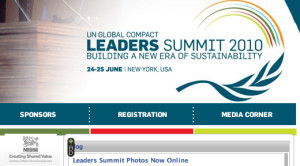
Nestle sponsors UN Global Compact 10th anniversary celebration
We are in on-going communication with Nestlé and have demonstrated to the GCO that executives refuse to end practices that violate the Global Compact Principles. The GCO should surely proceed to ‘review of the nature of the matter submitted and the responses by the participating company’ and then ‘remove that company from the list of participants and to so indicate on the Global Compact website’ as set out in the Integrity Measures.
One can only conclude that GCO is unwilling to apply the Integrity Measures due to the self-evident conflict of interest of Nestle being a sponsor of Global Compact events [example from 2013 and, above, from 2010], making the GCO financially indebted to the company.
The Global Compact Office closes cases without investigation
To keep the GCO updated on Nestlé’s on-going violations of the Principles we wrote to the GCO on 14 March 2014, attaching our latest correspondence with Nestlé (dated 3 March). We provided evidence of misleading statements included in the Communications on Progressposted to the UN Global Compact website (which bring the initiative into disrepute) and practices that violate human rights (which break the Global Compact principles).
The Global Compact Office replied to us on 29 April 2014, as follows:
With regard to the attached letter addressed to you from Nestle’s in response to your letter dated 3rd March 2014, we would kindly request that you please inform us whether you are satisfied with the content of the communication or if there are any other issues that should be addressed by the company. If not, please note that the matter will be considered closed by the Global Compact Office.
We responded on 9 May 2014:
If you read Nestlé’s letter you will realise that it is unsatisfactory as Nestlé is refusing to take action to stop the violations of the Global Compact Principles we have reported to it.
Rather than closing the case, it would be welcome if the UN Global Compact can provide the ‘guidance and assistance’ to Nestlé referred to in the Integrity Measures, encouraging it to take ‘actions to remedy the situation that is the subject matter of the allegation in order to align the actions of the company with its commitments to the Global Compact principles’. Please refer back to our letter of 3 March for the details.
The GCO said it had not received our original letter of 14 March 2014 (which enclosed a copy of our 3 March letter to Nestlé) so we sent it again. (We asked the GCO to investigate why correspondence sent to the address indicated on the Global Compact website had not been received as there may be other complaints that are being lost by the GCO, but have heard nothing from the GCO on this point.)
After we re-sent the information, the GCO contacted us on 11 June 2014, stating:
We have examined the matter and, as of now, we do not see any further role for the Global Compact in this process. Unless you have any additional issues that you would like to raise with the company for their response, please note that we will consider this matter closed under our Integrity Measures. 
Do you agree that the GCO has no role to play in encouraging participating corporations to stop violations of the Global Compact Principles when executives have indicated they will continue with these practices? Do you agree that corporations should continue to be listed under these circumstances?
No action taken against any corporation for violating the Global Compact Principles
We understand from our communication with the GCO that no company has ever been excluded for violating the Global Compact Principles following a complaint. Companies have been excluded for failing to provide Communications on Progress, but as these reports are posted to the Global Compact site even when they are misleading (as in the case of Nestlé), they are of little value in any case.
We look forward to your response to the questions raised in this letter and the clarifications requested in our letter to the GCO of 29 August 2011.
We will be publishing this as an open letter and will add your response, if and when we receive it.
Yours sincerely,
Mike Brady
Campaigns Coordinator
Baby Milk Action
CC: The Honourable Ban Ki-Moon, UN Secretary General.
Elena Bombis, Advisor, Legal & Policy, Supply Chain Sustainability, UN Global Compact.

Friday, 17 January 2014

Yemen still faces Challenges regarding Protection and Promotion of Breastfeeding

The Republic of Yemen presented its consolidated 4th periodic report on the situation of the implementation of the Convention on the Rights of the Child in the country.

IBFAN presented an alternative report to inform the CRC Committee on Yemen’s situation on the issue of infant and young child feeding.

General overview of breastfeeding in Yemen

With a low rate of children initiated to early breastfeeding (30%) and insufficient rates of exclusive breastfeeding till 6 months (12%), Yemen still has a lot to do in order to protect and promote breastfeeding among the population. Bad feeding practices, such as the habit of giving other liquids than human milk to babies and premature introduction of complementary foods are common, leading to high stunting and infant mortality rates. More than 53% of the children under  6 months are stunted and 57 children die before the age of 1 for every 1000 live births. Although the International Code of Marketing of Breastmilk Substitutes has been partially translated into law in 2002, its effective enforcement and monitoring has not been ensured. Moreover, there are no
 baby-friendly hospitals in Yemen.

Discussion on infant and young child feeding

During the presentation of its report, the Yemeni delegation has admitted that malnutrition is a crucial problem for Yemen, causing almost half of child mortality in the country. In 2012, some 58% of children were stunted, while 15% of them were in danger of death. Together with various international and national partners, the delegation reported that the Ministry of Health has launched different programmes addressing this important issue. An academic conference on malnutrition has recently been held and this topic is to be included in each curriculum for health professionals.  Other programmes have been launched, with focus on prevention and identification of solutions to improve nutrition for children and women, especially mothers. In addition, the government is currently developing a programme to raise awareness about breastfeeding among the population. Finally, a campaign focusing on nutrition in remote areas, targeting mothers and children, has started in 2013. 

CRC Committee members asked further clarifications on the information provided by the delegation. They addressed issues related to breastfeeding, such as the enforcement and monitoring of the 2002 law to protect breastfeeding and implement the International Code of Marketing of Breastmilk Substitutes, and the concrete efforts made to increase the rate of exclusive breastfeeding until 6 months. CRC Committee members also asked whether Yemen has the intention to increase its budget line for health in general, and what is the budgetary allowance allocated to tackle malnutrition. Finally, a question on the way to measure the results of the awareness raising campaigns on malnutrition has been posed.

The Yemeni delegation responded that in 2006, 11% of children under 6 months received exclusive breastfeeding, a percentage which the government is currently trying to increase to 20% by 2015. Besides, the project entitled “Programme for advice regarding nutrition of infants” provides a training module aimed at health professionals to increase awareness about breastfeeding. Regarding the budgetary allocations, the delegation explained that even though the Ministry of Health has no specific budget line for nutrition, 3.5% of its budget is devoted to fight malnutrition. For instance, the Ministry of Health is currently trying to address nutrition and hygiene issues through a national educational TV channel, where information is regularly transmitted. The government claimed its intention to increase the budget for health. Apart from its own budget, Yemen has received funds from international donors, such as UNICEF, World Bank, World Food Programme and International Medical Call, in order to tackle malnutrition through different programmes. According to the delegation, results of such programmes can be measured after 30-40 years only, depending on the issue tackled. The reduction of stunting and wasting among the population will be seen long time after measures have been taken, although field indicators show an improvement of nutrition status.

Finally, the delegation explained that since the law to protect breastfeeding and implement the International Code was adopted in 2002, the marketing of infant formulas is strictly regulated and infant formulas producers are allowed to advertise their products only if their allegations are based on scientifically verified measures. According to Yemen, the marketing of infant formulas within hospitals and clinics, such as free samples distribution, is currently prohibited. However, the issue of the monitoring and enforcement of the 2002 law remained unanswered.

CRC Committee's Concluding Observations

In its 
Concluding Observations, the CRC Committee made recommendations on the importance of data collection (para 18), on the right of the child to the highest attainable standard of health, mentioning the necessity to promote breastfeeding and implement the International Code of Marketing of Breastmilk Substitutes (para 56), and on HIV/AIDS programmes (para 64).

The CRC reminded Yemen its 2013 General Comment N°15 on the right of the child to the enjoyment of the highest attainable standard of health (art. 24) explicitly recognizes the importance of breastfeeding for the achievement of the right of the child to health. It urges States, in the effort of diminishing infant and child mortality, to devote particular attention to neonatal mortality and suggests, inter alia, to “pay particular attention to ensuring full protection and promotion of breastfeeding practices”. Moreover, “exclusive breastfeeding for infants up to 6 months should be protected and promoted and breastfeeding should continue together with appropriate complementary foods preferably until two years of age as feasible. States’ obligations in this area are defined in the “protect, promote and support framework”, adopted unanimously by the World Health Assembly in its 2002 Global Strategy for Infant and Young Child Feeding". Regarding Health and health services, Yemen is required to pay attention to CRC General Comment N° 15 on the right of the child to the enjoyment of the highest attainable standard of health (art. 24) and to “(a) ensure that appropriate resources be allocated to the health sector, with particular attention to specific maternal and child health care and develop and implement comprehensive policies and programmes to improve the health situation of children, in particular to respond to high rates of malnutrition and diarrhoea infections; (c) ensure access to safe water and sanitation services in rural and poorest areas [...]; (d) enhance efforts to promote exclusive breastfeeding practices, by ensuring the implementation and compliance with the International Code of Marketing of Breast-milk Substitutes, and establish a monitoring and reporting system to identify violations of the Code. This includes the establishment of baby-friendly hospitals with the promotion of breastfeeding from birth”.

The CRC Committee also stressed the importance of collecting disaggregated data on a comprehensive scale and therefore, urges Yemen to expeditiously improve its data collection system.
In addition, the Committee expressed its concern about the scarcity of information provided with respect to the implementation of the National HIV/AIDS Prevention and Control Programme, as well as about the limited provision of antiretroviral prophylaxis to prevent mother-to-child transmission and general stigmatization of HIV/AIDS within the Yemeni society.  Therefore, it urged the government to expand the coverage of the national HIV programme and to ensure universal coverage for HIV testing and free antiretroviral drug provision.

Saturday, 28 September 2013

China to strengthen legislation on food safety and the International Code

China presented its consolidated 3rd and 4th periodic report on the situation of the implementation of the Convention on the Rights of the Child. The next consolidated 5th to 6th periodic report is expected by March 2019. The Chinese delegation was composed of 44 members headed by H.E. Mr. Guide Jia, Deputy Director-General at the Department of Treaty and Law and Ministry of Foreign Affairs.
In view of the session, IBFAN presented an alternative report on the situation of infant and young child feeding in China, prepared by IBFAN East-Asia. The report shows that in China breastfeeding declined rapidly during the 1980s due to the promotion of breastmilk substitutes and inappropriate medical practices. With the implementation of BFHI since 1992 and of national regulation on the marketing of breastmilk substitutes (China’s Regulation) since 1995, breastfeeding’s superiority has been recognized and mothers are encouraged and supported to breastfeed their infants. However, breastfeeding promotion in community and work place has not yet received enough attention. One of the challenges regards the popularity of formula feeding and persistence of inadequate feeding practices related to giving water to infants 0-5 months. Another challenge is how to ban the marketing promotion of infant formula which undermines mothers’ confidence on successful breastfeeding. It is difficult for health authorities to supervise, conduct training and reassessments of the baby-friendly health facilities in China given the great number of concerned facilities (over 60 thousands). Finally, it is hard to ensure mothers’ entitlement to paid maternal leave and breastfeeding facilities, especially during the rapid social and live style charging in China.

Discussion on infant and young child feeding

During the dialogue with the government delegation, issues related to breastfeeding and infant and young child feeding have been raised by the CRC Committee, in particular relation to breastfeeding programmes and the baby-friendly hospital initiative (BFHI). The delegation of China did not address these issues in its responses. The Committee pointed out that the exclusive breastfeeding rate is falling, claiming that this is due to incidents of contaminated milk. The Committee insisted on the importance of establishing and reinforcing breastfeeding programmes, as well as promoting the Baby-Friendly Hospital Initiative. The Chinese delegation did not address these issues.
With regards to HIV and AIDS, the CRC Committee asked if there is any programme protecting young people and mothers.
The Chinese delegation answered that the government had implemented a project of HIV prevention and that to date, around 90,000 HIV-positive pregnant women have accessed appropriate services. This has led to a decrease of mother-to-child transmission rate.
Concluding Observations
In its Concluding Observations, the CRC Committee made recommendations on promoting exclusive breastfeeding, BFHI and on adopting the International Code of Marketing of Breastmilk Substitutes. The Committee also mentioned the importance of respecting child rights in relation to the business sector.
Regarding breastfeeding in particular, the CRC Committee was concerned “about the decrease in the exclusive breastfeeding and the incidents of contaminated infant formula in mainland China” (para 64). It strongly recommended that the government of mainland China: “(a) Intensify its efforts to reform laws and strengthen implementation of regulations on food and health safety standards, including for business sector and ensure that any officials or companies violating international and national environment and health standards are appropriately sanctioned and remedies provided when violations occur; (b) Collects systematic data on children affected and take all measures to ensure that all children and their families have access to effective redress, including free medical treatment and adequate compensation; (d) Promote exclusive breastfeeding and the establishment of Baby-Friendly Hospitals and adopt a Code of Marketing of Breast-Milk Substitutes with appropriate controls on the marketing of artificial infant formula” (para 64-65)
In relation to Health and health services, the Committee recommends that “mainland China strengthen its efforts to address, as matter of urgency, the existing disparities in health outcomes and resource allocations in order to ensure that all children enjoy the same access to and quality of health services, paying special attention to children in vulnerable situations, especially children living in poverty and rural areas and children of migrant workers. In particular, it recommends that mainland China take all measures to eliminate child and maternal mortality, including by improving health infrastructure and the availability and accessibility to emergency obstetric and neonatal care and skilled birth attendants at primarily health facilities in rural and poor areas.” (para 62)
The CRC Committee, in its General Comment 16 (2013), specifically calls on States “to implement and enforce internationally agreed standards concerning children’s rights, health and business including the [...] International Code of Marketing of Breast-milk Substitutes and relevant subsequent World Health Assembly resolutions”.
The Committee drew attention of China to its general comment no. 16 in the recommendations related to Child Rights and the business sector. It recommended to mainland China to strengthen the implementation of regulations in order to ensure that the business sector respects international and national human rights and complies with labour, environment and with child rights in particular. The CRC Committee therefore recommended that mainland China: (c) Establish monitoring requirements for all industries to undertake assessments, consultations, and full public disclosure of the environmental, health-related and human rights impacts of their business activities and their plans to address such impacts; and (d) Investigate and hold accountable government officials, including local officials, suspected of failing to uphold environmental regulations or preventing people from accessing information or medical care, and ensure that children and their families have immediate and full access to effective and medically approved treatment and long-term remedies, including rehabilitation services and compensation” (para 22-23).


Tuesday, 24 September 2013

Lithuania's lack of support for breastfeeding programme implementation

Lithuania presented its consolidated 3rd and 4th periodic reports on the situation of the implementation of the Convention on the Rights of the Child in the country. The consolidated 5th to 6th periodic report is expected by November 2018.
The IBFAN alternative report of Lithuania was prepared by the Initiative group of breastfeeding mothers and breastfeeding promoters of NGO "Pradžių pradžia" (IBFAN Lithuania). The report reflected the ‘Declaration on Breastfeeding Support and Relate Issues in Lithuania’ which was addressed to the highest authorities such as the Ministry of Health and Ministry of Education of the Republic of Lithuania, and was also shared with all universities and medical colleges and faculties of the country during the World Breastfeeding Week in 2011.

The report shows that in Lithuania, executive health policy does not direct any attention towards an integral programme on protection, support and promotion of breastfeeding. Dissemination of evidence-unbased information and misleading advertising is the key reason for refraining from breastfeeding or choosing a comparatively short period of breastfeeding. Article 24 of the Convention of the Rights of the Child is not appropriately respected and no mechanisms exist for control of its implementation: a comparatively large number of mothers continue refraining from or choose especially short periods of breastfeeding[1]. Thus, responsible state bodies that do not take action to encourage mothers to feed infants in a natural way, fail implementing public health strengthening actions based on disease prevention, which results in increased personal health care costs and sickness benefits. Currently, no substantial actions are taken to upgrade breastfeeding-related qualifications of health care specialists. Certain seminars on nutrition of infants and children for health care specialists are supported and organized by companies distributing breastmilk substitutes which violate the International Code of Marketing of Breastmilk Substitute and resolutions. What is more, accessibility to personal health care services for breastfeeding women is not sufficiently communicated and organized. There are very few baby-friendly hospitals and in other health care institutions, the quality of services is very low or services that ensure successful breastfeeding are nonexistent. Consequently, a birth-giving mother, limited by time and distance, cannot freely choose a health care institution. Mothers and newborns experience discrimination as they end up in a hospital without the BFHI status.

During the discussion between the government delegation and the CRC Committee, issues related to breastfeeding were not discussed.
Concluding Observations
We regret that the CRC Committee has made no specific recommendation on infant and young child feeding to the government of Lithuania in its Concluding observations.
In par. 39 and 40 regarding health care and services, the Committee regretted the decreasing budget allocations to maternal and child health care programmes. It reminded Lithuania to pay attention to its General Comment no. 15 (2013), which insists on “the right of the child to the enjoyment of the highest attainable standard of health, and recommends that the State party take measures to increase its budget allocations for maternal and child health programs. The Committee also recommends that the State party ensure maternal care for women who choose to deliver at home by providing access to emergency obstetric care, trained care at delivery, and post partum care.”


[1] Statistical data of research made at Health authority of Lithuania show that: just 30% of infant are breastfeed more than 0,5 year. For more see: http://www.tavovaikas.lt/kudikis/mityba-ir-sveikata/isaiskejo-kiek-sutaupo-seima-per-metus-maitinant-kudiki-krutimi.d?id=62015889

Tuesday, 11 June 2013

Children’s Rights in Guinea-Bissau at the CRC Committee

The situation of children’s rights in Guinea-Bissau has been reviewed by the Committee on the Rights of the Child (CRC Committee) at its 63rd session, on June 7th 2013.
IBFAN presented an alternative report on the country situation vis-à-vis infant and young child feeding. The report shows how, although improving, breastfeeding rates are still insufficient: only 38% of infants were exclusively breastfed for 6 months in 2010, and in 2012 72% of babies were initiated to breast within one hour from birth, while the introduction of complementary food is not timely for more than half of infants.
Inadequate breastfeeding practices contribute to the high child and maternal mortality rates in Guinea-Bissau, where 9% of children die before their first year of life. Breastfeeding promotion activities took place in the country thanks to international cooperation partners, however projects are expiring this year and the country does not have the means to maintain them on its own.

Maternity protection at work is another challenge for Guinea-Bissau, where maternity leave is as short as 2 months and the relative benefits are paid by the employer, situation which carries the risk of generating a discriminatory effect against women, as employers may want to avoid paying such benefits.

During the interactive dialogue between the CRC Committee and the country delegation, the issue of breastfeeding has not been addressed in detail but only briefly mentioned in the context of health care. On this point, the country delegation assured the Committee that the national health system extends to all national territory, including rural and remote areas. The country is engaged in developing health plans, including a strategic plan on HIV/AIDS, on water and sanitation, and a financial strategic plan to reach the millennium development goals that will cover breastfeeding promotion and maternal mortality reduction programs. Regarding reproductive health services, the country delegation noted that prenatal consultation is free and includes counselling to pregnant mothers.

Other issues debated at the session included a wide range of topics: child adoption, juvenile justice, birth registration, infanticide, paedophilia, violence against children, child labour, children in street situation, education, child marriage and children with disabilities.

The dialogue between Guinea-Bissau and the Committee has been very collaborative and the country delegation was well aware of Guinea-Bissau’s shortcoming in realizing children’s rights in the country; however it stressed that due to financial constraints many improvements are not achievable at the moment.

Wednesday, 5 June 2013

BREASTFEEDING IN UZBEKISTAN AT THE CRC COMMITTEE

At the 23rd session of the Committee on the Rights of the Child (CRC Committee) the situation of children’s rights in Uzbekistan has been reviewed on Tuesday 4th May. IBFAN presented its alternative report on the state of infant and young child feeding in the Country, noting the high infant and maternal mortality rates and the very low rate of exclusive breastfeeding at 6 months of age (only 26%).

The CRC Committee asked information on measures to prevent infant and maternal mortality and on breastfeeding practices and the implementation of the International Code on Marketing of Breastmilksubstitutes.
The Uzbek delegation mentioned two programs designed and implemented in the Country in collaboration with UNICEF, namely the ‘Growth and development for young children’ program and the ‘Breastfeeding’ program to monitor the health of newborns. As a result of these efforts, over the last 10 years the proportion of breastfeeding has increased to 80%.

It is not clear if the data provided by the delegation concerns exclusive breastfeeding and if it reports a national average or it relates only to focus communities involved in UNICEF programs, therefore such data does not provide a clear picture of the situation of breastfeeding rates in Uzbekistan.

The question on marketing of breastmilk substitutes remained unanswered.

Concerning maternal and infant mortality, the Country delegation reported a 10% of maternal mortality in 2012 and a 4% of infant mortality in the same year. These data are much lower than those reported by UNICEF in 2010-2008 (30% of maternal mortality and 44% of infant mortality) and it might be due to discrepancies in data collection, a general problem acknowledged by the Uzbek delegation and being tackled at the national level.